
GoodGym Liverpool



We plant; we do not bury
Saturday 17th October
Written by Naser (He/Him)
Planting Hope Among the Ruins of War On a Sunday afternoon in October, under a slightly chilly autumn sky, the group gathered at the Bombed Out Church. Some of our fellow GoodGymers had already taken part in the Saturday morning Parkrun, making this their second activity of the weekend. It is always impressive to see how much energy people can find for volunteering, even after an early morning run! It was particularly nice to welcome two new members to the GoodGym Liverpool family, and Ema also joined us for the session. After going through the plan and instructions for the day and introducing ourselves, we got started. Our task was to plant 600 daffodil bulbs. At first, it looked like a job that might take more than one session, but the group has a habit of taking on these challenges and getting things done. Naser started by turning over the soil, while the rest of the group worked together, planting the bulbs at a depth of around two to four inches. The larger bulbs went towards the back, with the medium-sized and smaller ones planted in rows and small clusters further forward. Before we could start planting, some parts of the area also needed clearing of weeds. The group quickly took care of that, and soon the ground was ready. As always, everyone was full of energy and enthusiasm. The friendly atmosphere and the spirit of working together seemed to make us forget the cold, and the time passed without us really noticing. GoodGym Liverpool has played an important part in looking after this place over the years. A quick look around is enough to see the difference. Only recently, the group had prepared the ground for new grass and given the tables and benches a fresh coat of paint. These might seem like small jobs, but together they make a real difference to the place.
A Church Without a Roof, but a Shelter for Kindness But this place deserves more than a few paragraphs about gardening and volunteering. It is not simply a green space or somewhere to carry out community activities. It is a church without a roof, yet in many ways it has become a shelter for kindness, compassion and all those who wish to stand against war. That day, our city’s roofless church was full of life. Many visitors had come to explore the site. While we were busy planting and working in the grounds, people wandered around, looking at the remains of the building and stopping to read the information boards. They came from different backgrounds and parts of the world. Each may have experienced war, conflict, and insecurity in their own way. Some have lived through war, others have heard about it from their families and communities, while some have only encountered it through films, books, and stories. But I imagine that almost everyone who visits this reminder of one of the most devastating wars in human history has a few questions running through their mind. If we had a pair of glasses that allowed us to see people’s thoughts, perhaps we would find someone asking: Wasn’t this a church? Wasn’t a place of worship supposed to be a sanctuary, a place where the vulnerable could find shelter? Shouldn’t the house of God have been a refuge for those seeking protection from violence and destruction? Someone else might wonder: Weren’t the opposing sides followers of the same faith? Didn’t they worship the same God? How could a place meant to represent faith, peace and sanctuary end up being reduced to ruins? Perhaps there is one simple but painful truth that we sometimes forget:
War has no God! Regardless of flags, borders, names or beliefs, war always leaves behind victims. More often than not, they are ordinary people who had nothing to do with starting it yet end up paying the highest price.
What Are We Planting Here? Maybe some visitors, seeing us planting flowers among the remains of a bombed-out church, might wonder what we GoodGymers are doing there. What are we trying to prove? Can planting a few hundred bulbs among all this destruction really make any difference? The answer is quite simple. We are not there to prove anything to anyone. We are simply doing our small part to bring a little more beauty, kindness, and peace into the world. We are messengers of beauty and peace. We believe that ugliness drives people apart, while beauty brings them closer together. We plant daffodils in the cold months so that, when spring arrives, they can bring a message of reconciliation and new beginnings. Among all the reminders of destruction, we plant something that represents beauty, happiness, and hope.
We plant; we do not bury. There is a deeper meaning behind these words, one that comes from my own Kurdish cultural background. In Kurdish, we have an expression of planting rather than burying when someone passes away. It reflects a way of looking at death not simply as an ending, but as the beginning of another journey. Something is returned to the earth, from which, in time, new life may emerge. This is why planting these daffodils feels particularly meaningful to me. We place these bulbs in the cold earth, knowing they will remain hidden for months before finding their way towards the light. We may not see what is happening beneath the soil, but we trust that life is quietly preparing to return. And so, among the ruins of a church destroyed by war, we plant rather than bury. We plant life where destruction once stood, hope where there was suffering, and beauty where violence left its scars.
We plant because we believe beauty deserves to be born again. Even the colours of the daffodils carry their own meanings. Their white petals remind us of purity and reconciliation, the yellow brings to mind happiness and joy, while the orange represents courage. Perhaps these flowers cannot change the world by themselves, but they can remind us that there are still things worth caring for. Daffodils are among the first flowers to appear as spring approaches. Just as winter begins to loosen its grip, they emerge from the soil, signalling the end of the cold and the beginning of a new season. That is why they have become such a powerful symbol of hope, renewal, and new life. And in a place like this, their meaning feels even more significant.
While They Make War, We Keep Planting Hope Some might ask whether we have become too caught up in symbolism. Can planting flowers and visiting a historic site really make a difference when wars are still taking place in different parts of the world? Are these efforts anything more than symbolic gestures? We come to a place that was devastated by war and bombing more than a century ago, while conflicts and violence continue to destroy lives elsewhere in the world today. There may be more than a hundred years between the events that destroyed this church and the wars we see happening now, but the consequences remain painfully familiar. For us, the message is simple:
If they continue to make war, we will continue to plant hope. These ruins remind us of that war, regardless of who starts it or who claims victory, leaves behind little more than destruction, grief, and loss. Yet there is something remarkable about seeing flowers grow in a place that was once reduced to rubble. Life finds its way back. Beauty returns to places where people once thought there could be nothing left. Possibly one day, those who make the decisions to start wars will stop for a moment and think about the people who will suffer because of them. They might think of a mother crying over the lifeless body of her child, a family losing their home, or someone forced to leave their homeland and everything they have ever known. Perhaps, if they could truly understand the pain they bring into the lives of ordinary people, they would think twice before giving the order to attack, before pulling a trigger or dropping a bomb. If only they understood that every mother’s tears send a tremor through the very fabric of existence, starting a war would never be such an easy decision. And this is where our small efforts matter. We may not be able to stop every war, but we can refuse to let hatred and destruction become the only stories our world has to tell. We can bring life back to places where bombs once took it away. We can choose kindness over hatred and build bridges between people instead of walls that divide them. That day, we planted 600 daffodil bulbs. A few months from now, when spring arrives, other visitors may walk through the same grounds and see those flowers emerging from the soil. They might never know who planted them, or how many hands worked together to prepare the ground. But hopefully, they will understand what those flowers represent.
We plant flowers so that destruction will not be the final story told by this place. Here’s to peace and reconciliation across the world, and in memory of all those who have lost their lives to war, in every country, of every language and faith.

Flumblings a Flatpack
Thursday 19th November
Written by Heetu
Well I turned up at Ms J who was lovely and welcoming but she was getting ready for her bed, 2 carers were helping as Ms J is paralysed. I was then determined that I should investigate the flat pack so I could help in some way. I was really hoping my flat pack puzzle enthusiasm would be rewarded tonight but honestly this one threw me. I realized it’s not always better to work as a lone wolf and that everyone needs help with something especially after a days work!
While talking to Ms J trying to get the flatpack pieces out, it was expected that the reclining sofa was electronic but this was a manual push recliner. It was soooo not the correct equipment needed for Ms J.
So my flatpack flummoxedness was not the only challenge we had. We decided instead that putting up outdoor bell in the daylight would be better for a next session.


Fab Four take on Footpath in Four Degrees
Monday 16th November
Written by Clara (She/Her)
Another very cold November Monday evening where we all felt it was in the minus temperatures, but was apparently four degrees. Four goodgymers met to support Urban Green Up with Helen on a site we've not been to for a little while. Three goodgymers braved the cold to run to the task.
We first got the equipment needed fr the task - litter pickers, spades and an edging tool. Our task was to litter pick the green and clear the footpath. We split into two groups with Sophie and me taking on the footpath with Helen and Aatefa and Max doing a litter pick.
Aatefa and Max made quick work of clearing the area and cleared so much. Five bags full. Having made light work of the litter pick, Max came and joined those of us on the footpath.
The footpath had been slightly obscured by some overhanging grass and weeds. We also realised there was a lot of gravel too. We had to strike a fine balance of not taking too much of the gravel up whilst we trimmed the sides to reveal the side of the path. We filled three big bucket's worth and slowly we started to see the edge of the footpath reveal itself.
We were opposite McDonalds which was wafting over smells of food making many of us who hadn't eaten a little hungrier. This started a lovely conversation about food and the recipes we make over the winter period to keep warm. Max shared with us the many meals he prepares and shares to support with his volunteering. Needless to say all this talk of food made us much more hungrier. Meanwile Aatefa, as always, so committed to a task had to be called back to stop so we could clear up, regroup and put tools back.
We cleared the area and the footpath and we look forward to returning again soon to do some planting.
Early Birds catches breakfast
Thursday 12th November
Written by Heetu
Woke up to a lovely bright cold sunny morning and toddled over to Ms J house literally a street away.
Ms J was trying to get a doctor’s appointment so we phoned and asked for a call back.
Then we could get to the task in hand, writing a shopping list: Sausages, Bread, Eggs, Malt loaf, …thinking these are all good breakie items then we got to more practical items…. Bleach and loo rolls!!!
So I pottered off to a couple of shops and returned Ms J shopping bag with goodies, all before starting work!


Don't throw the lentils out with the bathwater - live and let lentil
Monday 9th November
Written by Clara (She/Her)
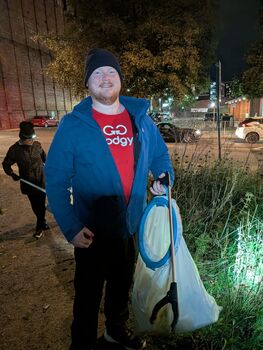
It was a cold November evening and many of us met at the task wrapped up in as many layers as possible. Sophie, Sallyann and Aatefa braved the cold and ran to the task. Here we met Khan who asked us to do some targetted weeding and litter picking. We formed into different groups. Miriam took on weeding the tree; Sophie and Jit (a very warm welcome Jit) took on weeding at the bottom of the community garden. Heetu took on weeding the perimeter. While Sallyann, Bekah, Aatefa, Craig, and I took on litter picking and clearing some rubbish. During the litter pick we found some interesting items including a bath, some cups and interestingly a bag of lentils. Aatefa and I continued to litter pick the area while the others went to support with weeding. Heetu and Craig made light work of tidying the weeds around the garden - making the entraceways look much neater. We posed for a photo and tried our best to show our goodgym tshirts. We also realised it had an interesting light, not too far off from the colour of the lentils we'd found earlier. During the weeding we learnt that Jit grows his own fruit and veg and knows quite a bit a about weeds. Excellent knowledge to have as I, for one, am often unsure. We also found out he is a writer so we were all talking about reports for Goodgym - we hope to read your first report soon Jit. Well done everyone for an excellent job on a cold November evening. Congratulations also to Craig on the 15th task!


Sea how we coasted through the K's in Abergele
Sunday 18th October
Written by Eleanor Crossley
Abergele was the lovely destination this time for goodgym to tackle another 5km and 10km race.
Sallyann and Vikky arrived early for the 5km and after a quick dabble in the arcades, headed off to do their 5kms. Soon after, the 10 kers arrived ( Eleanor, Bekah, Liam and Laura) just in time to watch Sallyann finish in the bright morning sun. We all gathered together soon after to greet each other and congratulate the race finishers. Despite being an organised double race, it wasn't a huge event which meant it had a calmer atmosphere which we all appreciated. And despite the chilly air temperature, the bright sun meant we could warm our backs in the sun (and some even found it too warm for running!).
The 10km race soon started and we all set off at our own paces. While Bekah and Liam were seasoned runners, it was Laura's first 10km in several years and Ellie's first! We ran along the seafront to the sound of seabirds and waves until a rather steep (and surprise) hill! Not long after was the turning point which meant runners at the front could high five those running the opposite direction which was a nice uplift on a long run. The 10kers all finished the race within the dreaded 1.5 hour cut off time and everyone was pleased with their result.
In the meantime, Sallyann and Vikky were enticed into the arcades once more and became well acquainted with the 2p machine, so much so that they managed to win a bunch of tickets! Unfortunately this was only enough for a fraction of a small fluffy key ring so they kindly donated them to a family with a young child nearby. Luckily aftwards there was still time to snap some photos of the 10kers as we neared the finish line.
After collecting medals and discussing the course, we headed out together to Llandudno for a well deserved lunch. We had a quick (and notably uphill) walk round the sites before choosing our favourite Welsh cafe for a delicious lunch. Afterwards we parted ways and went in various car shares back home for some R&R till next year!
Loading...